WOMEN DELIVER 2026 RECAP: A Week of Advocacy, Discussion, Enlightenment and Empowerment
25 May 2026
The 2026 Women Deliver Conference ran from 27 April to 30 April 2026, hosted for the first time by the Oceanic Pacific — in Narrm (Melbourne), Australia. WiAD Chair, Jill Scanlon, attended the conference and shared some key takeaways below.
A week of advocacy, discussion, enlightenment and empowerment – in a nutshell, that’s what a Women Deliver conference is.
Held every three years, acknowledged as one of the largest gender equality conferences globally, the 2026 iteration made a trip down under, and hosted in partnership with the Victorian State government, it all unfolded at the Melbourne Convention and Exhibition Centre (MCEC) alongside the Yarra River on the edge of the CBD.
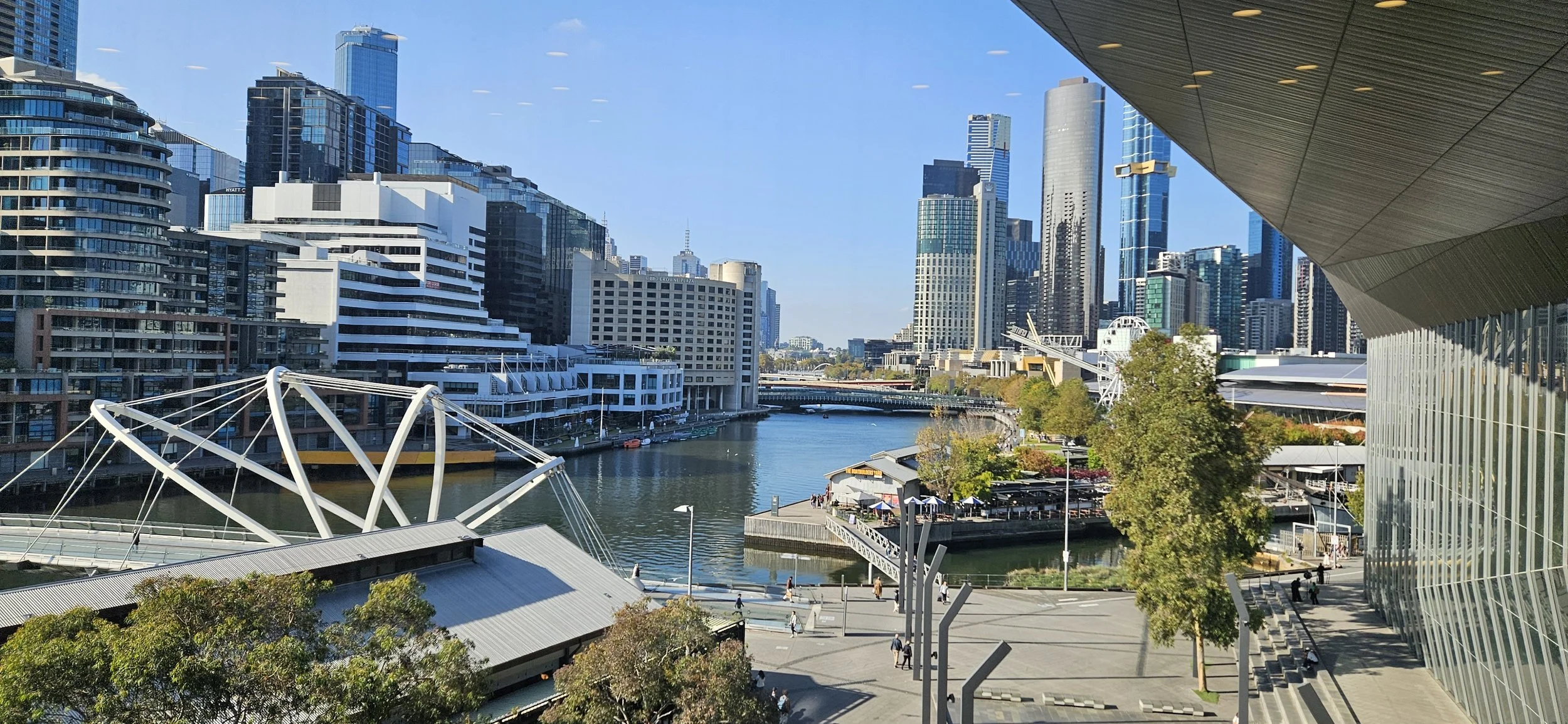
And finally, I was in its midst - a week I’d been waiting to experience for over a decade.
This latest edition was promoted as having a strong Oceanic Pacific focus, which was proven to be a worthwhile strategy with the final numbers showing that 44 per cent of the more than 6,100 people who attended, from a record 189 countries, came from the Oceania region.
Being in the expansive MCEC venue with so many people from different countries, different cultures, with different experiences in the development space, served only to boost the adrenalin up a notch when you realised that the varying sessions across the complex, being held in meeting spaces large and small, open and closed, were all underlined by a common theme – Gender Equality and women’s space in the global landscape.
And We’re Underway
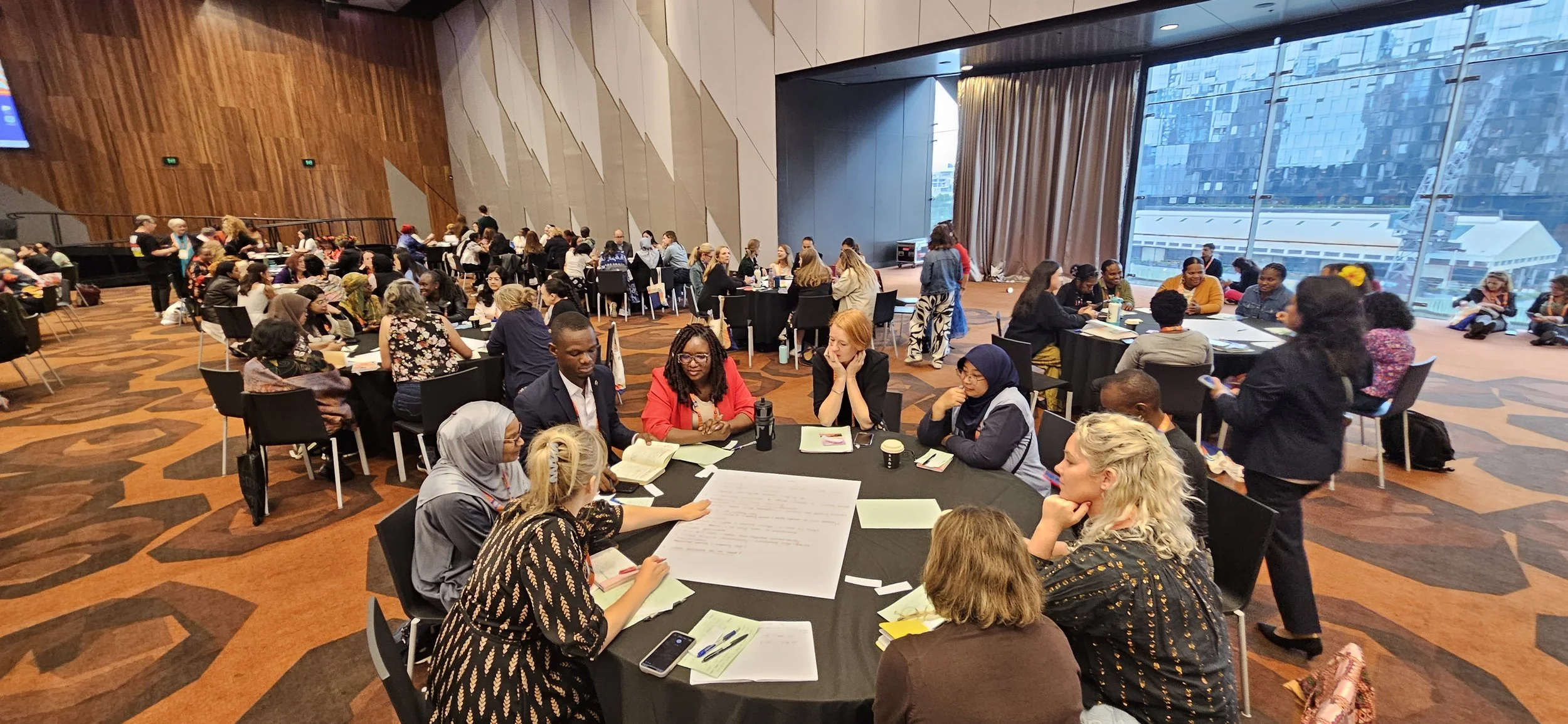
With a packed schedule, the main agenda kicked off with an interesting pre-conference session titled ‘Roots & Rising: Gender & Climate Justice’ - that posed many questions to about 300 people in the room, over about 4 hours on the Monday morning, before the official Opening Ceremony slated for later in the afternoon.
All were gathered around tables ready to listen, brainstorm and discuss development themes and practices relating to the topic of climate change and climate justice, as it impacts women and gender issues across the globe.
Some of the key questions posed for dissection were: What’s NOT working well? What IS working well? What alliances do we need? ... and perhaps most importantly, what gives you hope.
It was an exercise that elicited discussions and conversations based a lot on experiential practices and outcomes. And I found myself at a table with people from Nigeria, Indonesia, the US, the UK, Hong Kong, and of course, a couple of fellow Australians, sharing and then collating our thoughts into point form, with the mandatory sheet of butcher’s paper in the centre of the table awaiting our insightful jottings, which would later be shared among many in broader spaces.
The overarching themes that came out of the session were:
The value of community voices
The importance of collaboration at ALL levels, to realise impactful outcomes
The importance of acknowledging local, traditional land and practices as part of the conversation
The adaptation at community level to the increasing impacts of climate change are among the common threads relating to climate, country and culture
The general commentary also underlined the need to value unpaid work – especially by women in communities – as having sustainable and irreplaceable impact, with all of us being part of an eco-structure that can be built on.
It was an engaging session which got many minds from many countries and cultures exchanging thoughts and experiences and got the week off to a great start!!
The Opening Ceremony, as perhaps expected, was both a platform for indigenous welcome and performance, and a formal introduction, with a parade of speeches from luminaries and leaders including the CEO of Women Deliver Dr Maliha Khan, former Australian PM Julia Gillard, the Deputy Secretary General of the UN Amina Mohammed, the PM of Tuvalu the Honourable Feleti Penitala Teo, the Governor General of Australia Sam Mostyn and the Victorian State Premier Jacinta Allen: now that’s an opening with some clout, laying the foundation for a big week ahead.
Tuesday proved to be a long day with both gender development and the Pacific a focus for me, as well as some specially targeted Sport4Development sessions, which are my familiar home.
But before getting to the first S4D session of the week, I decided to sit in on a broader discussion on the future of the United Nations, which again presented a panel of diverse voices from women in senior international leadership roles, both at the UN level and beyond, and those who are just emerging on that pathway. Points raised were focused on the purpose and future of the UN and should efforts be looking at reviewing or rebuilding, with a need to work continually for multilateralism and to influence the international system and change the course of representation for women. A key final point came from the youngest member of the panel, an impressive young woman from Mozambique, Jocast Samuel, who advocates for women’s leadership in her country, noting that when we advocate for women needing to be ‘at the decision-making table’ it should also be remembered that is a first step, “Being invited to the table is only representation, it does not equate to (actual) power”.
Sport4Development
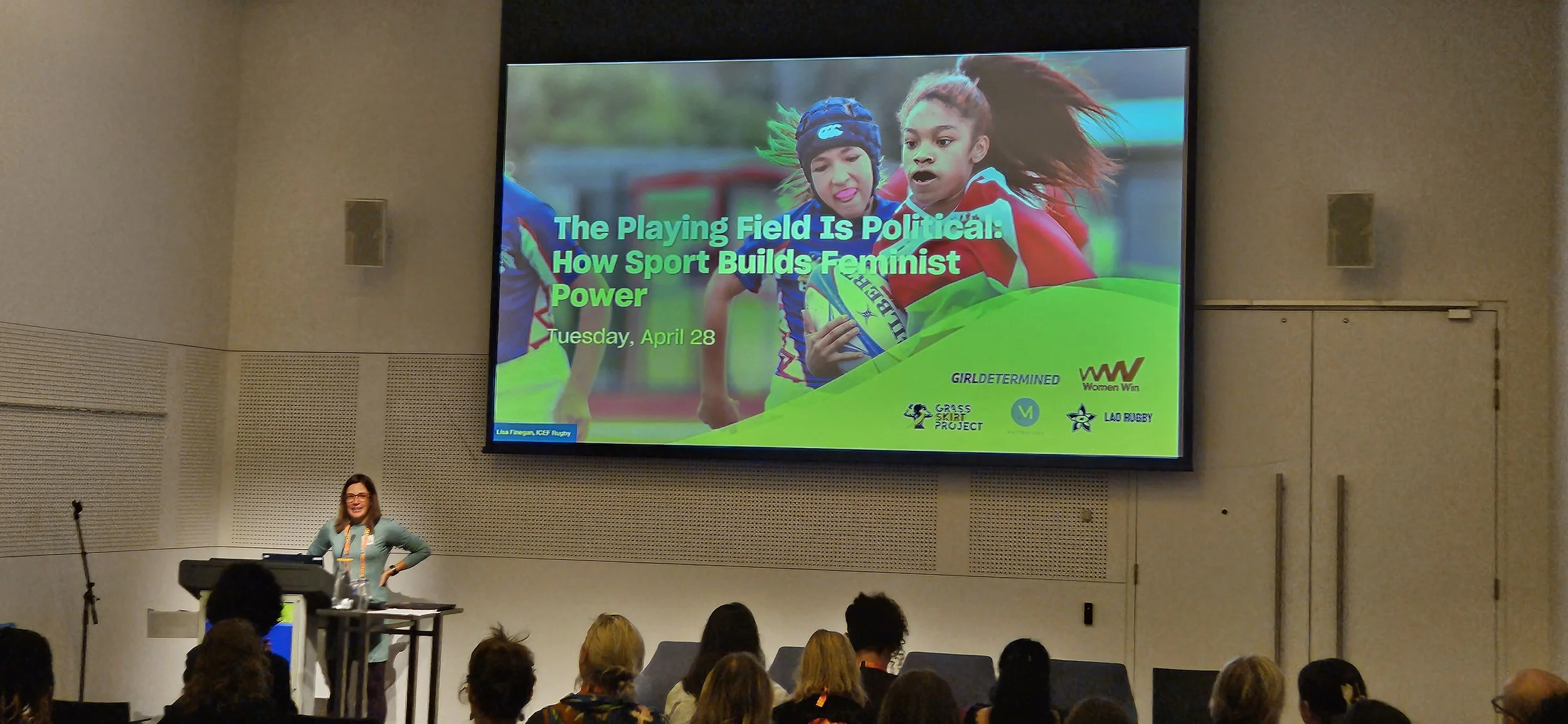
So, into more familiar territory and a session on ‘The playing field is political: how sport builds feminist power’, hosted by Women Win – an international organisation which works on collaborations and strategies around funding, with a focus on girls’ rights through sport, women’s economic resilience and democratisation of philanthropy.
The discussions explored the concept of silos and intersections in the S4D space, with the overwhelming conclusion that women overall think of sport as being intersectional. There was also much discussion about the role of boys and men in furthering the gender empowerment space for women, through sport, with PNG and the Grass Skirt Project featured as a key example of what can be achieved, with the premise that males could and should be seen as potential agents for change.
A follow-up to this discussion was one a couple of days later, which highlighted the need for and impact of expanded investment potential in the S4D sector, broadening the notion that social change through sport usually comes through public funding support, ignoring the impact of private or corporate investment for social change; a new direction being hotly pursued due to falling funding opportunities in the traditional spaces.
Discussion explored the disconnect between what happens at the funding level and the lived experience of people in the community, with local engagement deemed necessary because they know how to find solutions: it should be about community co-ownership, not only consultation which is extractive – it’s about value-adding – with decisions in communities being seen as relational, not transactional, with relationships the key to all outcomes, especially in the Pacific. And more importantly, the need to include women at the governance and capital level.
Climate
While keeping my personal focus on S4D sessions during the week, I also had my eye on some of the discussions on one of the key themes of the conference, which was Climate Change and all its intersectional impacts. These could be found in open meeting spaces such as the Climate Hub, as well as small meeting rooms and larger plenary sessions – the conversations were ongoing. Climate stories through the lens of gender-based violence (GBV); the climate finance perspective, where it’s not just the physical damage but the personal and human impact of a climate incident, such as a cyclone or dislocation, with climate migration being a noted cause of trauma, especially for women; recognising the strong connection between climate stress and women’s safety.
Another intersection in the climate change discussion was that of nutrition. Climate impacts nutrition in 3 ways:
Food – supply & quality
Services – cyclones, floods, droughts, see services fail (inaccessible or diminished)
Time depletion – more time spent on community response efforts and looking for water and food, and less on nutrition, breastfeeding, food preparation, childcare, health, etc.
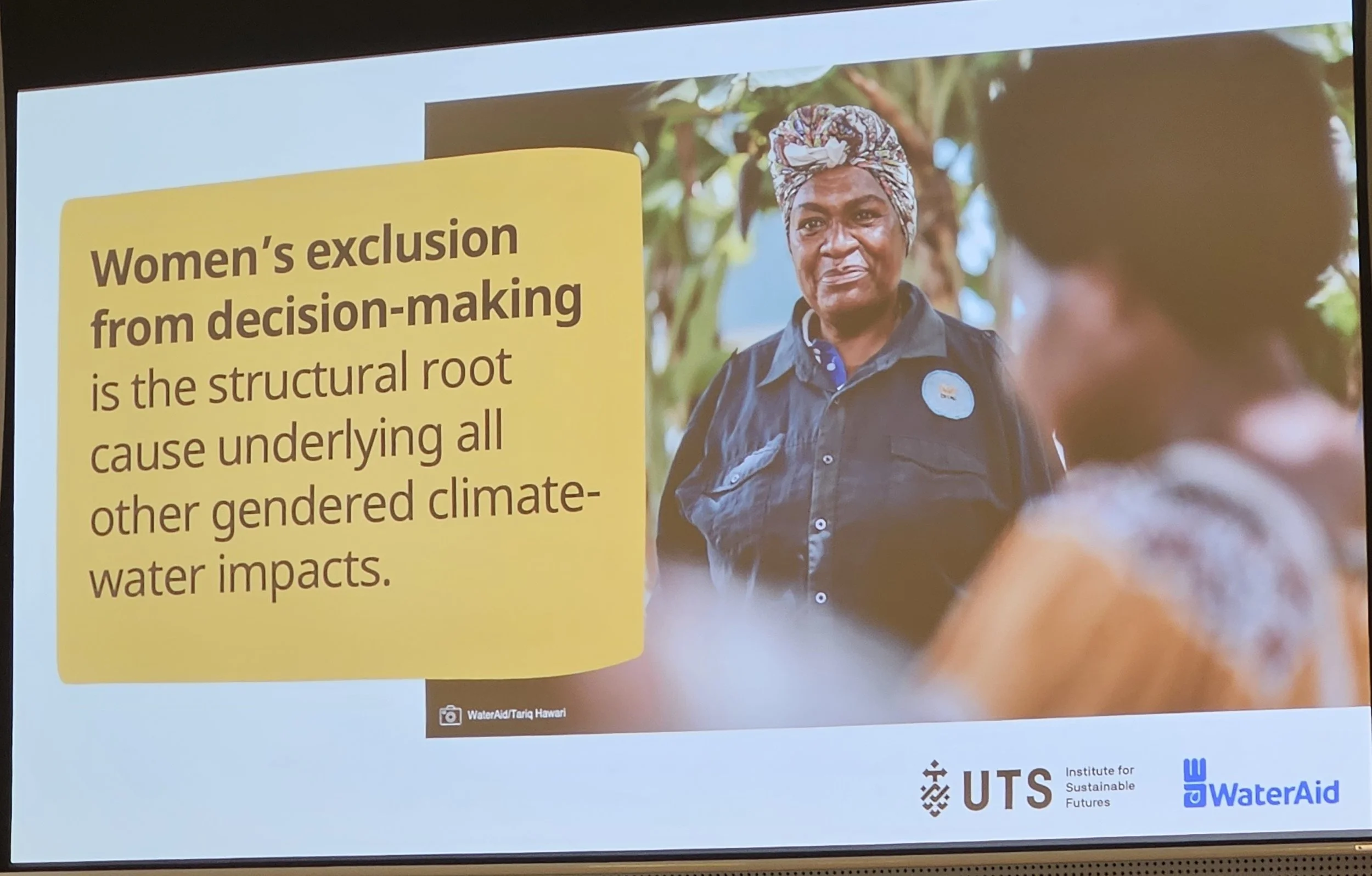
The conclusions drawn were that women need to be at the centre of climate crisis planning with respect to food and nutrition, with the need to transform gender norms through a climate lens and to look more closely at the interconnectedness of gender, climate and nutrition, noting that nutrition is not only a health issue, but is now slowly being recognised as a gender issue with a gender impact. Climate adaptation was also raised as being key in transforming household and community practices in relation to gender equality.
That’s A Wrap!
Now, while there is so much more I could tell you about the people and stories of the week, that would make this a much longer read than it already is.
Suffice to say that by the end of the conference, the body, mind and soul had been put through a lot – all of which added to this experience.
Final thoughts, conclusions, outcomes of a week spent at WD2026 were that among the most important factors in the global gender equality space are connection, collaboration, the importance of building community, and the need for collective action to bring about system change and gender equality.
This was underlined by the long-awaited delivery of the Melbourne Declaration for Gender Equality which is a collective vision and global call, co-created by WD and 650 global advocates over a couple of years, outlining a shared strategy founded on care, justice and solidarity to ‘rebalance the ecosystem for accountability, rights and a future of gender equality’.
An heavily applauded takeaway, as was proudly proclaimed at the Closing address, was that Women Deliver is never a conference, it’s a Community!